



Anxiety and anger might seem like two separate experiences, but they’re often closely connected.
When stress and worry overwhelm your mind and body, frustration and irritability can surface in response. While anger can arise for many reasons, it often shows up to protect us from vulnerability or perceived threat. Understanding this connection is important in responding to anger skillfully and without letting it take control.
key takeaways
Purpose of Anger: Anger serves as a natural protective reaction to perceived threats and vulnerabilities, helping to defend against injustice, boundary violations, and other forms of mistreatment.
Managing Anger: There are two problematic ways of responding to anger: acting it out aggressively or suppressing it entirely. Both can lead to negative outcomes if not handled appropriately.
Effective Strategies: Understanding what triggers your anger, exploring how you learned to react, letting go of negative mental processes, strengthening awareness, and improving communication skills are key steps to managing anger constructively.

THE PURPOSE OF A DIFFICULT EMOTION
How Anger Protects Us
Like any emotion, anger serves a specific and necessary purpose.
It’s a natural protective response to:
Injustice
Boundary violations
Blocked goals
Pain
Vulnerability
Mistreatment
Can you imagine being in any of those scenarios and not feeling angry? In fact, vulnerability lies at the heart of each of these experiences. The more vulnerable we feel, the more likely we are to perceive something as a threat — and anger is one response that can be mobilized in defense.
The purpose of anger is to protect vulnerability and neutralize threat.
But when anger arises, there are two common reactions that can become problematic if not handled well:
Acting it out
Suppressing it
✦ Learn More: To understand more about how your brain responds to threat with both anxiety and defensiveness, see From Alert to Alarm: The Spectrum of Vigilance, Anxiety, and Fear.
THE APPEARANCE OF OUTWARD ANGER
When We Act Out Protective Anger
Acting out anger is obviously the most visible, and reactive, expression of the feeling. It’s the emotional equivalent of a spear and shield, used to deflect pain and fend off perceived threats.
When used constructively, anger can fuel assertiveness and protect against harm. But when it’s acted out unhelpfully, it comes out as:
Criticism
Blame
Sarcasm
Dismissiveness
Escalating demands
Harsh limit-setting
Threats
Physical aggression
One reason this type of anger is difficult to manage is because it often feels justified, like a way to “right a wrong.” That sense of righteousness can make the behavior seem acceptable, even when it causes harm. In these moments, it’s easy to overlook more constructive ways to respond to injustice — ways that protect your values without resorting to aggression.
✶ In Depth: For more on how we justify reactive behaviors under stress, see When Values Become Vices: How to Avoid Justifying Unhealthy Behavior.
THE EFFECTS OF HIDDEN ANGER
When We Suppress Protective Anger
Suppressing anger, on the other hand, comes from trying to cut it out of your life. This often comes with self-criticism, judgment, and feelings of shame for having the anger. There’s a desperate urgency to get rid of it. You might succeed in appearing calm, but often at the cost of your emotional wellbeing.
Suppression isn’t the same as refraining to express anger.
Refraining means accepting its presence, making space for it to exist, and choosing not to act on it because doing so wouldn’t be helpful or appropriate. The key difference is that you’re not spending energy resisting the anger — you’re recognizing that it isn’t dangerous and doesn’t have to control your behavior.
✷ Don't Miss: For more on how your body holds and communicates emotion, see Your Body is Speaking - Are You Listening?.
A STRUCTURED APPROACH
5 Steps for Responding to Protective Anger
When it comes to managing protective anger in a healthy way, here are five practices to consider:
Step 1: Understand What the Anger is Protecting
Anger often arises in response to a perceived threat — whether to your safety, self-respect, beliefs, goals, autonomy, or sense of belonging. Vulnerability lies beneath each of these areas. The more vulnerable you feel, the more likely your mind is to mobilize anger in defense.
When anger is intense, frequent, or disproportionate, it may be because your mind is working overtime to protect something it perceives as under threat — even when no threat is actually present.
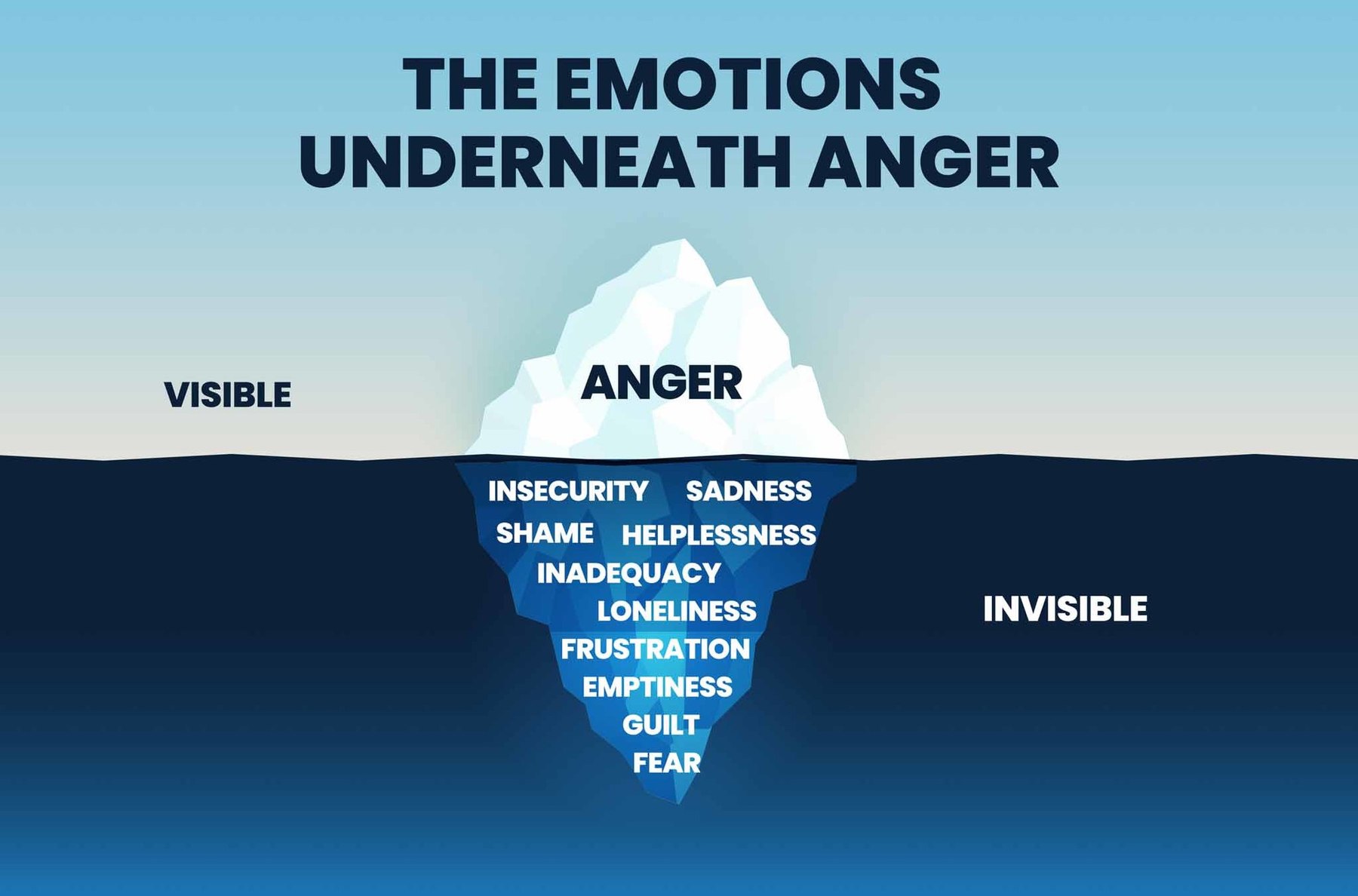
Like an iceberg, this vulnerability is often hidden beneath the surface. But it’s the driving force behind the protective response.
Reflection prompts:
► Are the situations that trigger my anger tied to protecting my beliefs, values, identity, goals, or deeper needs?
► What vulnerable or sensitive emotions might be lying underneath the surface in those moments?
Step 2: Explore How You Learned to React
Our emotional responses are shaped by both biology and environment. While genetics influence temperament and reactivity, much of how we express anger is learned.
If you tend to act out your anger, you may have grown up in an environment where anger was expressed openly or aggressively. If you suppress it, perhaps you were taught to keep the peace, avoid conflict, or protect yourself in emotionally overwhelming settings. Experiences with emotionally dismissive or rejecting caregivers, teachers, or peers can also contribute to sensitivities you may now react to in adulthood.
Reflection prompts:
► How did I learn to react to anger in the way I do?
► Do the patterns I notice connect to experiences or messages I received earlier in life?
Step 3: Let Go of Mental Habits That Fuel Anger
Without healthy tools for managing anger, it’s easy to fall into cycles of blame, judgment, or resentment — often expecting others to regulate what we haven’t yet learned to manage ourselves.
Sustainable emotional growth requires taking ownership of your anger.
This means letting go of the belief that others are responsible for fixing how you feel, and instead turning inward to do that work for yourself.
Blame and resentment may feel protective in the short term, but they keep you dependent on others for emotional resolution. Healing begins when you stop waiting for others to change and commit to your own well-being.
Step 4: Strengthen Your Awareness
Mindful awareness allows you to hold anger lightly without reacting to it or pushing it away. You learn to notice the emotion, feel it in your body, and observe it without judgment.
You’re not suppressing. You’re not indulging. You’re simply allowing it to be, knowing that it isn’t dangerous and doesn’t have to dictate your behavior.
Helpful internal responses:
► “I can’t control what others say or do. Their choice of words and actions are not my responsibility. I can let the words be without reacting to them.”
► “I know where this anger comes from and what it’s trying to do for me. I can decide not to push it away or use it as fuel for more anger. I’m getting better and better at letting it be and experiencing it for what it is.”
These small shifts in self-talk can help you stay grounded and in control.
Step 5: Strengthen Your Communication Skills
Expressing anger constructively can feel risky, especially if you fear conflict or lack the skills to navigate it well. But healthy communication is essential for resolving problems and upholding healthy boundaries.
Start with a simple affirmation or reminder:
► "If I need to assert a healthy boundary or get a need met, I can do so without attacking."
This involves speaking for anger rather than from anger in ways that are clear and not explosive.
Examples:
► “Here’s what I feel. Here’s what I need.”
► “Here’s the situation as I saw it. Here's what would help me in the future.”
► "Here's what I want. And here's why it's important to me."
► “Please don’t do this again. I don’t like it.”
► “Here’s what I’m going to do next to ensure this doesn’t happen again.”
The language used and level of assertiveness may vary depending on the context, but it should never become an attack. It’s about communicating with clarity, not overpowering others.
✸ Also! To learn more about how anger can negatively affect communication with loved ones, see Conversational Landmines: Avoiding 7 Common Communication Traps.
PRACTICING HEALTHY RESPONSES
Managing Anger Well
When channeled effectively, anger can drive meaningful change and strengthen your personal resolve. It can help you stand up against injustice, advocate for your needs, and pursue constructive solutions.
But without skillful management, even protective anger can spiral into aggression, suppression, or lasting resentment. Recognizing the line between helpful and harmful expressions of anger, and practicing healthy strategies for responding to it, makes all the difference.